
Public Access to New Mexico Arrest Records
New Mexico treats arrest information as public, yet no single statewide search covers every arrest, booking, case, and photo. State law recognizes public arrest information and blotters. But the right to inspect a record does not force an office to post it on the web. A county jail may run a current roster. An arresting agency may hold an incident report. A court may show how a case ended. Every record type has its own custodian and its own rules.
No dedicated New Mexico statute makes police or jails post every adult booking photo online, and no general state law bars a publisher from charging to remove a copy. That narrow answer does not settle whether a photo is public or private; court orders, privacy laws, and local release policies still matter. The New Mexico recent-arrests lookup points to official county sources. Each county posts whatever photos it chooses.
New Mexico Public Arrest Record Categories
The Arrest Record Information Act, or ARIA, spells out its public categories in NMSA 1978, Section 29-10-7. The list is broad. Wanted posters and lists qualify, as do original chronological police blotters that law or custom requires. So do records of public court proceedings, published court opinions, traffic offenses, accident reports, clemency announcements, and anonymized statistics. A blotter is a chronological log of agency activity, not a jail roster or a full case file.
Agencies keep latitude. ARIA lets an agency disclose public arrest information tied to an adult's offense while that person remains in the criminal justice system. It may also confirm earlier arrest information in response to a specific inquiry that fits a public category. No feed is promised. The law sets no update time. Nor does it promise a web post or a booking photo.
The blotter language traces to 1953. It was enacted in 1977 and amended in 1993. Older annotations list possible blotter details. They cannot guarantee current county rosters show them, so read each entry as the fields the source provides.
Note: A current custody list may show only people still held, while the underlying booking record can remain with its custodian.
New Mexico Arrest Record Privacy
ARIA's confidentiality rule is not a blanket seal over every uncharged person's information. It protects confidential sources and methods. It also shields certain details about an uncharged person. That applies when government holds them in a record about someone charged. Other IPRA exceptions can still apply. When an office says no, ask for the legal basis of the denial.
ARIA's own-record provision works differently. A person can seek their own arrest information after identity checks, through counsel, or through an authorized agent. That access is personal, not a direction to publish the record to everyone. The text of Section 29-10-4 shows those defined limits.
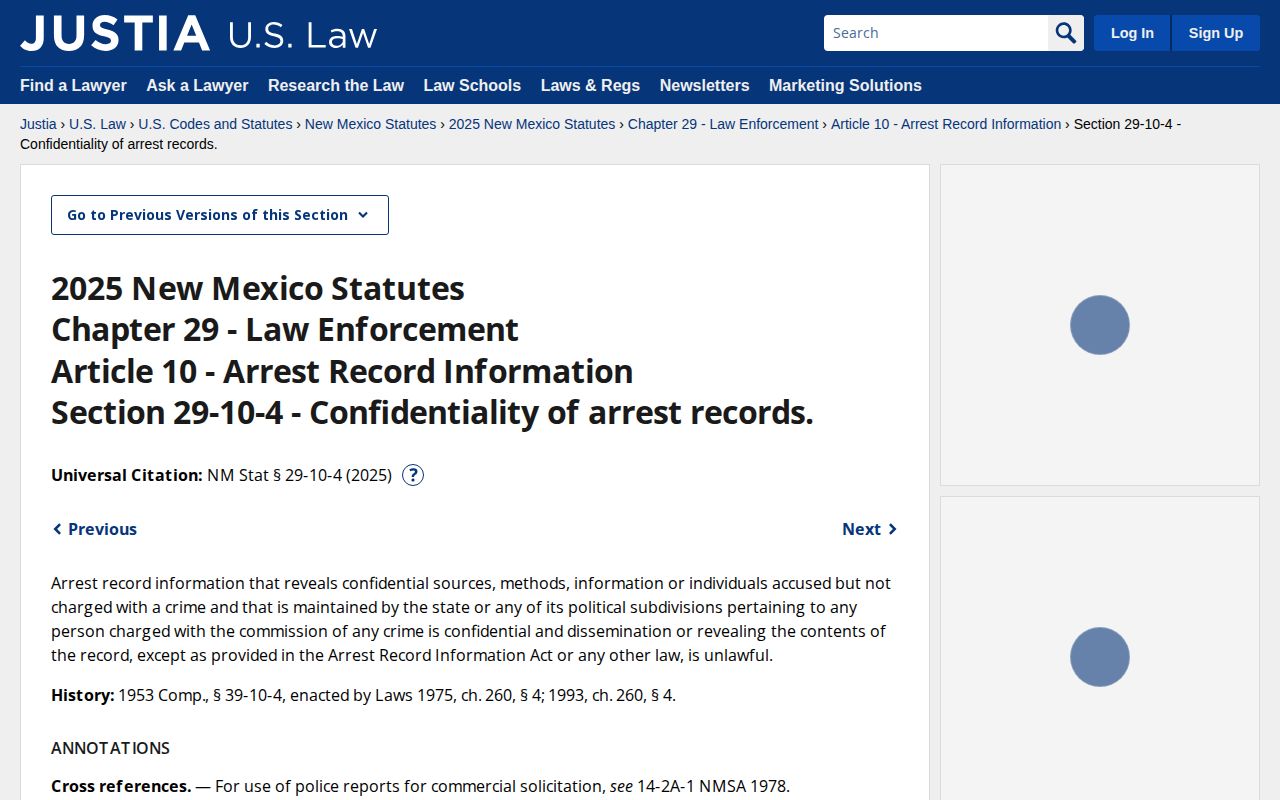
The record type and the way the information is held both matter.
Request New Mexico Arrest Records
The Inspection of Public Records Act, or IPRA, gives people a broad right to inspect existing government records. Legal exceptions still apply. No reason is needed. A request just needs the requester's name, contact details, and a clear description of the records. A date range and a record type, like an adult booking sheet or incident report, are easier to search than "all arrests."
The New Mexico Department of Justice's IPRA instructions say an office should allow inspection as soon as practical, no later than fifteen calendar days. Slower than three business days? Then the requester should get a written response with an expected date. A denial must state its reason. Inspection and electronic copies are free. Physical copies carry DOJ rates: seventy-five cents per standard page, one dollar for a larger page, and ten dollars for a CD or DVD. County and agency fees may differ. A focused request can follow this order:
- Name the county or agency, facility, date range, time zone, and record type. Add a known case or booking number if available.
- Ask for electronic delivery. For a booking, name the fields needed, such as booking date, charge, bond, release date, and photo if public.
- Ask for non-exempt portions and the law behind any redaction or denial. Keep the request, response, invoice, and related court order.
Ask the jail about custody, the arresting agency for its report, and the court for the filed charge and outcome. DPS incident files run differently. Send those through its GovQA/IPRA request portal. A person's own repository check goes through the DPS Law Enforcement Records Bureau. That route requires a complete, legible, notarized release with an original signature and a $15 money order or cashier's check. It is not a search of every local booking.
New Mexico Court and Booking Records
Different offices hold different pieces of an arrest. A jail roster only shows who is in custody right now. A name can vanish from it the moment someone is released. The booking sheet may still sit in the agency's file. The arresting agency keeps its own report of the event. The court keeps whatever case was filed and how it ended. The New Mexico Corrections Department offender search is a different animal altogether. It covers state prison plus probation and parole, not fresh county bookings. These records disagree sometimes because each one tracks a separate event. For court matters, the statewide New Mexico Courts Public Access system can help locate a case, hearing, or disposition. It has limits. It does not prove a booking happened. It also does not display every court document. Juvenile criminal cases stay off the public screen. A portal summary can leave out papers the clerk still holds. An official copy of a complaint, judgment, or disposition may be needed. Ask the court clerk for a certified version.
- Booking
- The receiving facility's intake and identification process. It can follow an arrest, warrant surrender, transfer, or other custody event.
- Blotter
- An agency's chronological public activity record. It is not a complete roster or case file.
- Disposition
- The court or prosecutor's outcome, such as a dismissal, acquittal, diversion, conviction, or sentence.
Note: A court case can clarify the outcome, but it does not replace the jail's record of who was booked or when.
New Mexico Juvenile Arrest Records
Juvenile records in New Mexico get special protection. The Children's Code treats a child's records, local detention records included, as confidential except for people and agencies the law allows in. NMSA 1978, Section 32A-2-32 draws that line. The New Mexico Judiciary's public access guidance confirms juvenile criminal cases never appear in its public case interface. A booking photo does not turn public just because an outside publisher copied it somewhere. So do not repeat or repost juvenile details. A parent, a lawyer, or another authorized person should ask directly. Contact the court or agency about access. If a record is marked juvenile or sealed, stop sharing it and contact the office that holds it.
New Mexico Expungement and Booking Photos
New Mexico built its expungement law recently. The Criminal Records Expungement Act took effect in 2020 and was amended in 2021. Section 29-3A-2 defines "arrest records" broadly, sweeping in booking sheets, photos, fingerprints, and other identifiers. Expungement pulls eligible records out of general public access. That includes court and agency websites. It means relief can cover a booking photo just as easily as a docket entry. Cases that ended without conviction get their own path. Section 29-3A-4 generally allows a petition one year after final disposition. Qualifying outcomes include acquittal, dismissal, no bill, diversion, or conditional discharge. The statute's conditions must be met, and no other relevant case can be pending. The petition itself is sealed or filed under a pseudonym. Notice goes to the district attorney and DPS. A conviction raises the bar. Section 29-3A-5 generally requires a completed sentence. Fines and fees must be paid. A clean waiting period with no other conviction is also required. The wait is two years for a municipal offense or misdemeanor. Four years apply to an aggravated misdemeanor or fourth-degree felony. Third-degree felonies carry six years, second-degree eight, and first-degree ten. A Crimes Against Household Members offense falls under the ten-year period too. Exclusions exist as well. Some crimes against children are left out entirely. So are offenses involving death or great bodily harm, sex offenses, embezzlement, and DWI. Before filing, check the current court forms and the exact charge. The New Mexico Courts expungement page links the current forms for cases with and without convictions. It also explains where petitions go.
Note: A court order can cover official booking photos because the statute includes photographs in its definition of arrest records.
New Mexico Cannabis Record Relief
Cannabis records get a faster route. Section 29-3A-8 allows automatic relief for eligible cannabis-only records. The timing generally runs two years after a conviction. It can also run two years after an arrest that never led to one. For a person under eighteen, the clock runs two years. It can also stop at age eighteen, whichever arrives first. The judiciary must verify and clear records under the statute. Automatic relief does not fit every file. A mixed record or a charge outside the law may need a separate court process. A "drug arrest" label does not guarantee the record counts as cannabis-only. Check the court's current instructions before assuming anything has been cleared.
Correct a New Mexico Arrest Record
Start any correction with the office holding the disputed fact. A wrong booking date, name, or charge belongs with the jail or the arresting agency. Write to them and state the exact field. Give the correct information. Include the record number if you have it. For a court outcome, go to the court clerk. Ask the custodian to fix the source record and explain how the change will appear. Never send sensitive identity papers through a public comment or social media form. Expunged cases need their own follow-through. Send a copy of the court order to each relevant government custodian. Ask that the covered public record be restricted. One office receiving the order proves little. It does not mean every agency or private publisher has acted on it. Once the official record is corrected or removed, a person can ask a search engine to refresh an outdated result. That may clear a stale link. It cannot promise every independent repost is gone.
| Path | What it can change | Key limit |
|---|---|---|
| Official correction | The record held by the jail, police agency, court, or state custodian | Contact the office that owns the record; one office cannot update every copy. |
| Court expungement | Public access to eligible arrest and case records, including covered photos | Eligibility, waiting periods, exclusions, and court orders apply. |
| Publisher policy | A secondary publisher may correct, suppress, or remove a copied entry | Each publisher sets its own voluntary terms and asks for its own proof. |
| Search result refresh | A stale link or preview after the source page changes | It does not remove the source page or a separate repost. |
Keep the paper trail: the source page, your request, the order, and the response date. If access is denied, ask for the legal basis and any non-exempt portion, since a missing page alone does not prove lawful destruction.
Free Publisher Policies Vary by Site
Secondary publishers copy arrest records from government sources. Their New Mexico sections are uneven and often stale. The jail, agency, or court comes first. A publisher's removal policy is voluntary, not a state law. RecentlyBooked's removal policy charges no fee. That applies to a listing that is dismissed, expunged, sealed, wrong, outdated, juvenile, or duplicated. It asks for the source page, identifying details, a reason, and court papers when needed.
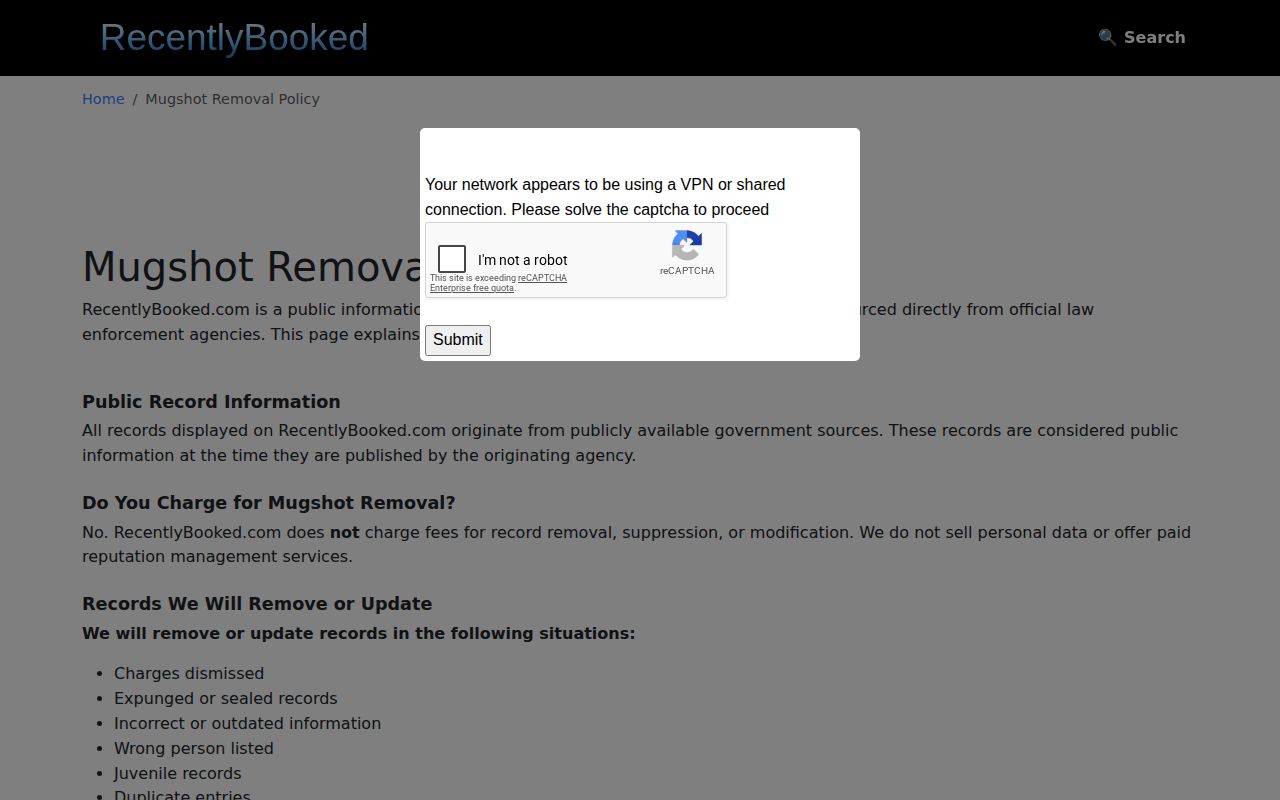
Keep in mind that is one publisher's policy, not state law. Sites set their own rules. Response times differ too, so follow up and confirm the listing actually changed.
Mugshots.com’s Record Maintenance policy says eligible updates and removals cost nothing. You send the site's record ID and signed court papers. It quotes up to ten business days, though no timing is guaranteed.
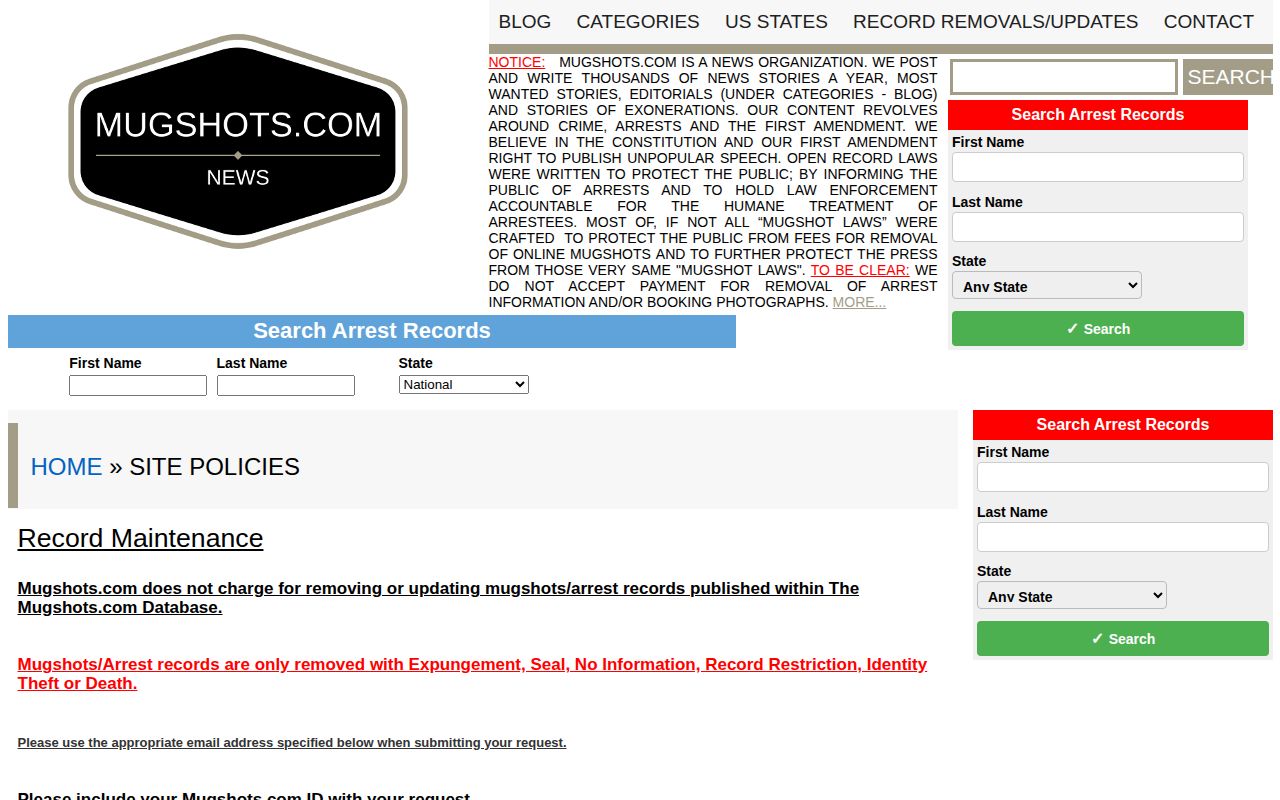
This is an old archive, not a live county roster. A displayed add date is not the arrest date. Trust only an official record on that point. Mugshots.zone’s About page describes a contact route. It covers records that should be sealed or expunged. Its removal form did not load reliably. Confirm the site’s proof rules and timing directly.
Policies differ, and each publisher can act only on its own copy.
Note: Correct the official source first, then make a separate, documented request to each publisher that copied the record.
New Mexico Record Retention Periods
New Mexico has no single retention clock. Arrest records and booking photos fall under schedules instead. Schedules sort by series, custodian, and trigger date. Some fingerprint and crime-reporting files run ninety-nine years. That span does not mean every county keeps each booking photo online that long. A roster can vanish fast. The booking record behind it may sit under a longer local schedule, so ask which approved series applies, what event starts the clock, and whether a hold or expungement order changes it. A 2006 sheriff schedule is historical only. The State Records Center and Archives retention schedules are a starting point for state records and historical collections, though an archival file is not a live booking feed and its access terms differ from a public roster.
Note: A record's disappearance from a search page alone does not show whether the office retained, transferred, or lawfully destroyed it.