
New Mexico Police Blotters and Logs
New Mexico law treats the chronological police blotter as a public record. Blotters kept by law or custom fall squarely in the open-records category under Section 29-10-7 of the Arrest Record Information Act. That promise has limits, though. Nothing in ARIA orders a single statewide arrest site. Nor does it require a daily web post, or full jail data on every log. A sheriff may post a partial blotter. A jail may list current custody only. A police department may issue incident updates instead. Each record answers a different question, so know which one you are reading.
Why look at multi-day sources at all? A first search may have run too early. A date filter can beat a live roster, and some agencies keep dated files going back years. Still, gaps exist. County logs often skip people released within hours. State police releases highlight major incidents, and papers pick a handful of cases. The New Mexico arrest log landscape is a patchwork of separate records, not a statewide count of every booking.
For the newest bookings, the Arrests Last 24 Hours page splits recent and current-custody results from these wider blotter and archive sources. The two views are not the same feed.
What a New Mexico Log May Show
ARIA's annotations list the kinds of details a police blotter can hold. They promise nothing about any agency's current page. Treat the table as a reading aid, not a statewide template. Rely only on what the official source itself shows. Skip repeating private identity details a summary does not need.
| Possible entry field | How to read it |
|---|---|
| Name or identifier | Match by more than a common name when the source gives a record number; a same-name result alone does not establish identity. |
| Arrest date, time, or place | Read the field label closely. Arrest time, booking time, and post date can differ. |
| Offense or charge | Preserve the source's wording. It may be an initial code or charge. |
| Arresting officer or agency | Use this to find the incident report holder. The arresting agency may differ from the jail holding the booking record. |
| Custody or release terms | These details often belong to a detention system and may not appear in a police blotter at all. |
Older legal annotations mention extra identifying fields. That does not make them standard on today's pages. Never copy a home address, full birth date, or contact detail into a public summary. A photo may not be part of the blotter at all. Each New Mexico agency sets its own lawful record interface, within ARIA, IPRA, juvenile rules, and any other applicable limits.
New Mexico's Multi-Day Sources
The label on an official source tells you what kind of log you have opened. A date query can reach further back than a fresh roster. Even so, it only covers that system's records and search choices. Dated PDFs carry their own publication dates. An archive folder does not mean every day is inside it. Live pages change, and a newer timestamp may appear at any time.
| Source type | New Mexico example | Window and scope |
|---|---|---|
| County booking-date report | Santa Fe County Booking Log Report | Searches calendar days; it is not a rolling 24-hour list and photo display depends on the record. |
| County detainee inquiry | San Juan County booking-from and booking-to fields | Date-filtered booking history can include custody and case fields, but no fixed statewide update promise exists. |
| Dated roster or sheriff archive | Colfax County daily roster directory and an older monthly blotter | Snapshots and older files may be selective. Keep the date printed on the file. |
| State police activity archive | New Mexico State Police press archive | Event releases cover selected enforcement and incidents, not every state-police arrest or county booking. |
| Local news jail log | Regional newspaper logs and stories | Editorial or transcribed records can lag, omit cases, correct details, or sit behind a subscription. |
New Mexico State Police posts public releases on selected enforcement. Those cover checkpoints, saturation patrols, fugitive apprehensions, and major incidents. The NMSP press archive records those published events. It is not a daily roster of everyone booked after an NMSP arrest.
Colfax County handles archiving two ways. Its detention page links dated daily rosters. Meanwhile, the sheriff site keeps an older monthly blotter example. The two formats show local style choices, not a uniform statewide retention rule.
Note: A press-release date identifies publication, not necessarily the arrest or booking date shown in a county log.
Find a New Mexico County Log
Read the county's source label first, then choose where to search. The County Directory routes you to local government sources, and the right office depends on the record type you need.
- Identify the arresting agency or county jail named in the report. If the county is not clear, confirm the location before searching by name.
- Open the county's official detention, sheriff, or police source and look for a dated log, booking report, blotter, or archive tab.
- Choose a calendar date or date range and note the page's update label. Do not treat a post date as a booking date.
- For a missing or older record, ask the agency that holds it for the correct report series and an Inspection of Public Records Act (IPRA) request route.
- Check the court's case record for filed charges and later disposition. A police log alone cannot resolve the case outcome.
New Mexico News Blotters
Local news has real value here. A paper can preserve a jail log. It can also report an arrest that never reaches a county roster. Remember that a story is an editorial product. It is built from a short time range, selected charge labels, or a statement from law enforcement. The Las Vegas Optic jail log is one dated local example. Eastern New Mexico News runs its own regional format. Neither counts as a full New Mexico booking database.
The Eastern New Mexico News log capture is editorial, not an official feed. Its jail log can run late. It can pick only some names, get corrected, or sit behind a subscription.
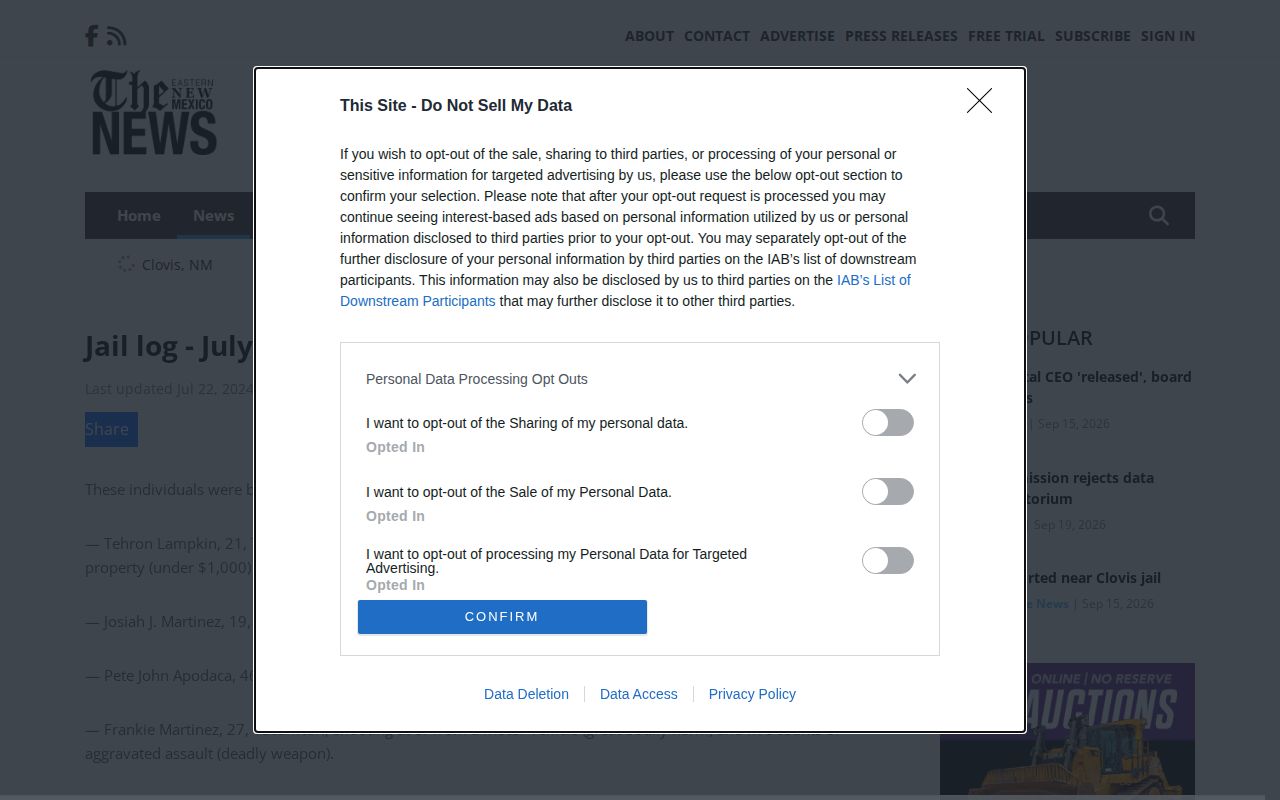
Use news as a starting point for context, not as the last word. Confirm a person's status with the county custodian and any filed court case. A post date is not an arrest date, a booking date, or a release date. Outcomes come later, elsewhere.
One secondary publisher, Mugshots.com New Mexico, keeps an uneven state archive. It is not an official blotter or a complete county feed. A "date added" label there means nothing without checking the government source. The Mugshots.com New Mexico index shows the publisher's county labels. It does not show a verified statewide total.
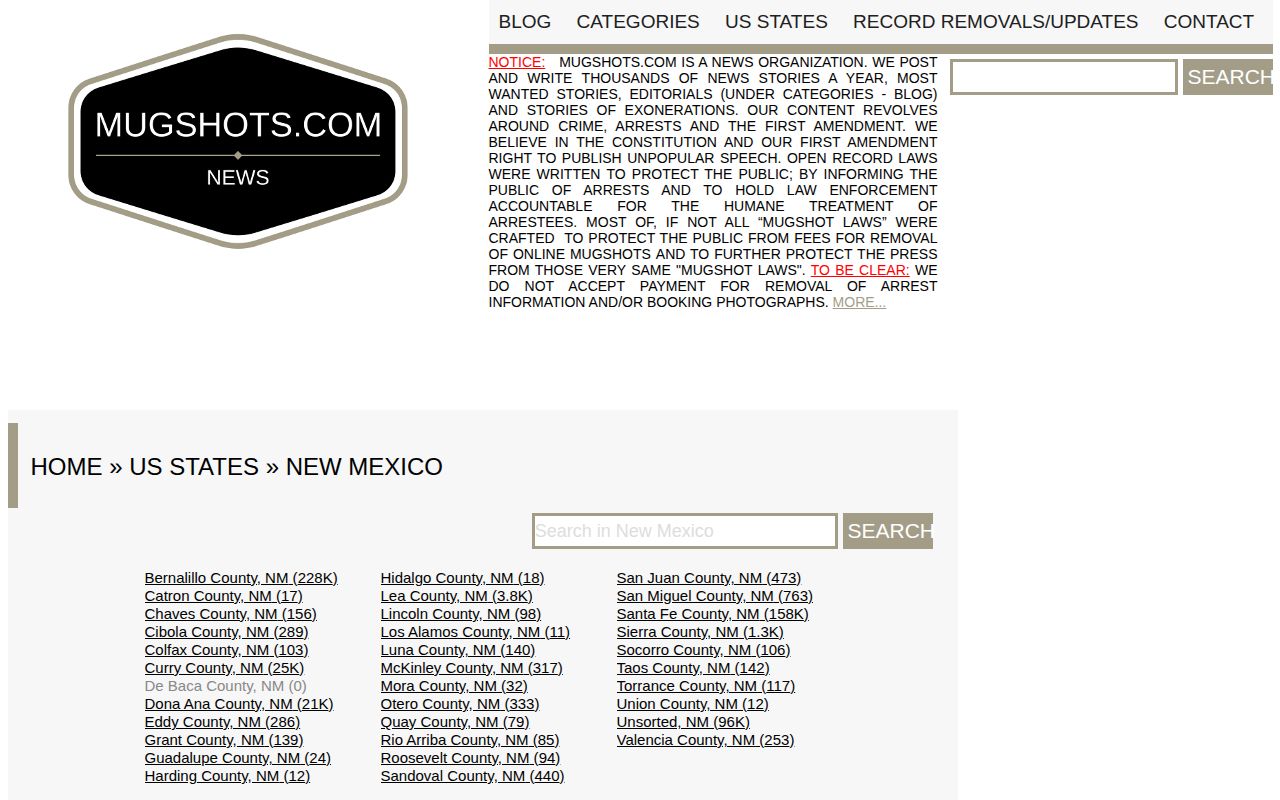
Treat it as a discovery lead only. County and court records control the official booking and case status, while the publisher's coverage may be historical, partial, or stale.
Weekend New Mexico Arrest Reports
Weekend and holiday arrest records rarely appear on a weekday rhythm. A county posts once staff finish a booking review. A news desk may compile its jail log a day late. Some weekend roundups land after the next business day. So a Friday-to-Monday page can look like a surge of arrests when it is really just a delayed batch. That trap catches a lot of readers. A multi-day window helps you locate records, yet the post date alone says nothing about when the booking actually happened. Look instead at the report's date range. Check the booking date inside each entry. Note any "updated" label too. A current custody roster shows who is in custody now, but it cannot confirm an arrest fell within the dates a news log covered.
For a possible new booking, skip the news log and go back to the county's current custody view. The blotter works best for context, date ranges, and older arrests. It is no substitute for a live custody check.
New Mexico Log Archives and Requests
A roster can vanish from the web. The booking record may still sit in an approved record series. New Mexico sets retention record by record, not through one blanket booking-photo period. The State Records Center and Archives publishes functional retention and disposition schedules. Those cover state records and agency file plans. County records fall under a separate local-government schedule. Before a custodian claims a record was destroyed, ask for the record series. Also ask for its retention trigger, any legal hold, and its final disposition.
One state series keeps central crime-reporting repository and fingerprint-identification records for 99 years from creation. That figure says nothing about how long a county leaves a booking photo online. A 2006 sheriff schedule allowed five years after final court disposition for some adult criminal-history records. Treat that as history, not current statewide policy.
New Mexico's Criminal Records Expungement Act counts booking photographs as arrest records. A valid order treats covered proceedings as if they never occurred. See Section 29-3A-2 and Section 29-3A-7. An order binds government record holders. Private copies may need separate notice and time for search results to refresh. A stale search hit is not proof an expunged record is still legally public.
For older holdings, start with the New Mexico Archives Heritage Search. It offers finding aids for archival collections, not a live arrest feed. Then contact the repository in hand with the details. Bring the agency, county, date range, record series, and collection identifier.
An archival record may carry access or privacy limits. It is not proof of current custody either. The agency may still hold the file. A related court or county record may sit somewhere else entirely.
For a current record, send a narrow Inspection of Public Records Act request. Send it to the custodian who holds it. Name the county or agency, date range, record type, and any known booking or case number. State your preferred electronic format. You do not have to explain why you are asking. Request all segregable non-exempt portions and the legal basis for any denial. Under current IPRA guidance, the custodian must respond immediately or as soon as practicable. The deadline is 15 calendar days. Three business days may pass without an answer. The office should then tell you when to expect one. Inspection is free, though reasonable copy or storage costs may apply. Read the New Mexico DOJ IPRA guidance for the current rules before filing.
When an official file gets corrected, note the correction date. Ask any publisher that copied the old value to update its story. Search engines lag behind the source. An archive shows what was retained. It should never be used to revive a later-sealed booking photo.
Sierra County's detention page has carried a roster maintenance and security-audit notice. For a live status update, trust the current official page rather than an older jail-software link.
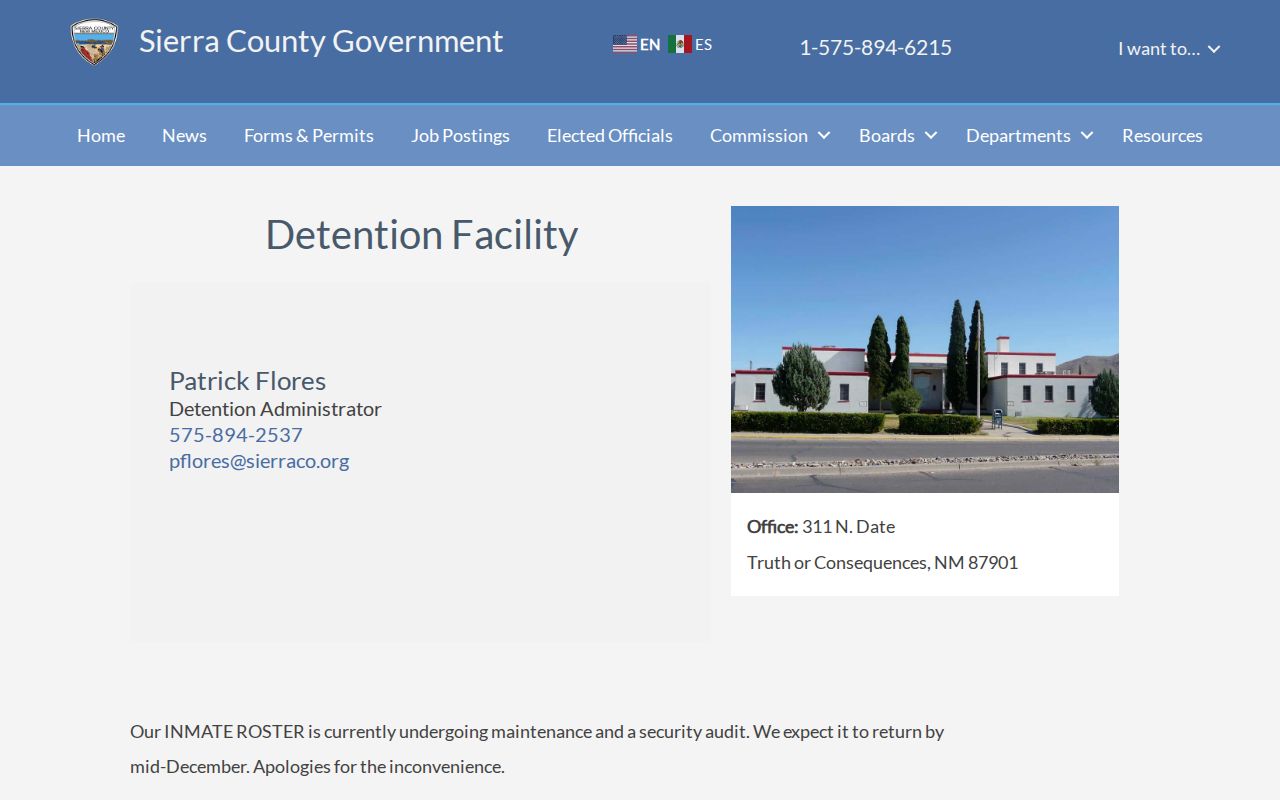
A maintenance notice explains one access gap at one moment. It does not prove records are missing or that the roster stays down today.
Note: An archive file shows what the agency retained under that record series, not a complete statewide arrest history.